Free tool
AI is built for tasks, not jobs
A big job is just a lot of little tasks in a row. Drag the sliders and watch what happens.
Try it
A job is just a bunch of tasks in a row. Drag the sliders and watch what happens when AI tries the whole job by itself.
One slip-up anywhere and the whole job fails.
Each task is checked, and tried again if it slips.
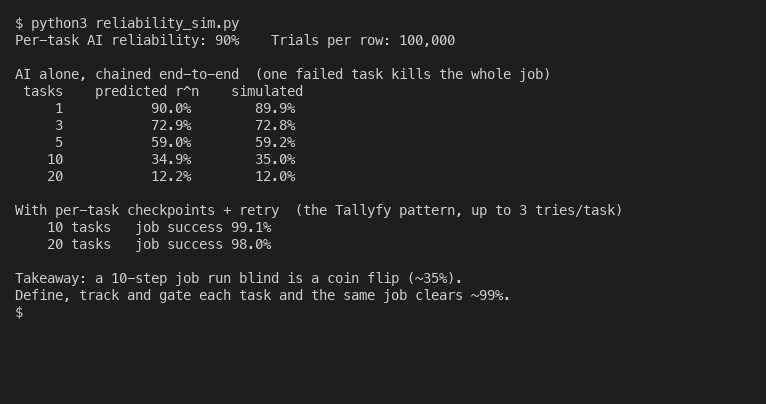
90% per task, 10 tasks in a row, is about 35%. A 10-step job done blind is worse than a coin flip.
Start free with TallyfyThe lesson: give AI one task at a time, not a whole job. Tallyfy makes that easy.
Show the proof and the sources
Here is the math. If AI gets each task right 90% of the time, and the job is 10 tasks long, the whole job only works when all 10 work in a row. That is 90% multiplied by itself 10 times, which lands near 35%. No single task got harder. The chain did the damage.
A control layer flips it. It checks each task and tries again if one slips, so a 90% task effectively clears 99.9% and even a 20-task job stays near 98%. Same AI, same per-task hit rate. The only change is structure. That is what Tallyfy is: each task gets an owner, a deadline, a check, and a clean handoff, whether the doer is a person, an AI agent, or a rule.
Run it yourself
The calculator uses plain probability. This short simulation flips a real weighted coin per task across 100,000 trials, so you can see the simulated numbers land on the predicted ones. It is seeded, so you get the same result every time.
import random

random.seed(42)
TRIALS = 100_000


def chain_success(n, r, trials=TRIALS):
    """Autonomous chain: the job succeeds only if all n tasks succeed."""
    wins = 0
    for _ in range(trials):
        if all(random.random() < r for _ in range(n)):
            wins += 1
    return wins / trials


def gated_success(n, r, attempts=3, trials=TRIALS):
    """Gated chain: each task gets up to attempts tries before the job fails."""
    wins = 0
    for _ in range(trials):
        ok = True
        for _ in range(n):
            if not any(random.random() < r for _ in range(attempts)):
                ok = False
                break
        if ok:
            wins += 1
    return wins / trials


R = 0.90
print(f"Per-task AI reliability: {R:.0%}    Trials per row: {TRIALS:,}\n")
print("AI alone, chained end-to-end  (one failed task kills the whole job)")
for n in (1, 3, 5, 10, 20):
    print(f"{n:>6}   predicted {R ** n:>6.1%}   simulated {chain_success(n, R):>6.1%}")

print("\nWith per-task checkpoints + retry  (the Tallyfy pattern, up to 3 tries/task)")
for n in (10, 20):
    print(f"{n:>6} tasks   job success {gated_success(n, R):.1%}")
Where this comes from
- Economists model automation as acting on tasks inside a job, not the whole job. Acemoglu and Restrepo: automation shifts the task content of production, task by task.
- Anthropic's guide to building effective agents favors workflows of predefined steps, making each call an easier task.
- METR measured near 100% success on tasks under four minutes, and under 10% on tasks past four hours.
Learn how Tallyfy does it