How to map your as-is business process properly
Map your as-is business process through employee input before fixing anything. One Tallyfy case study showed a team saving $1 million after discovering 65 employees performing undocumented workflows.
UML was created in 1994 by engineers at Rational Software to standardize system diagrams. Of the 14 UML diagram types, activity and use case diagrams handle 80% of real-world business process documentation needs.
Streamlining business processes means cutting waste and fixing broken steps. IDC research shows inefficiency costs companies 20 to 30 percent of annual revenue. Map, analyze, improve and enforce for results.
Onshore outsourcing contracts firms or freelancers in your own country, offering advantages over offshore alternatives. Nine key benefits include easier communication, better quality control, cultural alignment, stronger intellectual property protection, and cost savings that often beat offshore rates from countries like China while supporting domestic job creation.
APQP was created by AIAG to build quality into every phase of product development instead of catching defects after production. Five phases prevent failures that cost manufacturers 10x more to fix after launch than in planning.
McKinsey research shows 70 percent of change initiatives fail to reach goals, mostly due to employee resistance. A structured change management process using proven models like ADKAR and Lewin Unfreeze-Change-Freeze addresses both the technical and emotional sides of organizational transition, making new ways of working permanent instead of temporary.
A statement of work defines deliverables, timelines, and acceptance criteria before work begins. PMI research shows scope creep hits over half of all projects when the SOW is unclear or missing.
The 5 whys technique, developed by Taiichi Ohno at Toyota, asks why repeatedly until you reach the true source of a problem. Roughly 87% of issues resurface within 90 days because teams fix symptoms, not the broken system underneath. Most root causes turn out to be embarrassingly simple
Buffer research shows 67% of remote workers report better flexibility in time management. This guide covers tools for each business function from Slack for communication to Tallyfy for workflow tracking.
These workflow examples cover the four universal functions every business needs: onboarding, approvals, forms, and incident response. Tallyfy data shows onboarding workflows appear in over 860 customer conversations.
A process defines what needs to happen. A procedure spells out how to do it. Gartner research shows 60% of AI projects fail without proper process foundations. Confusing these two concepts just automates chaos faster.
Why set project milestones? George T. Doran's SMART framework shows how milestones help with realistic planning, team coordination, and motivation while keeping projects on track and within budget.
The TIMWOOD framework, developed by Taiichi Ohno at Toyota, identifies seven types of waste that drain profit from any operation. Here is how to find them in your own processes before they compound.
Total quality management turns every employee into a quality controller. Coca-Cola learned this the hard way with New Coke - the end user decides quality, not internal opinions. TQM principles embed continuous improvement in your culture.
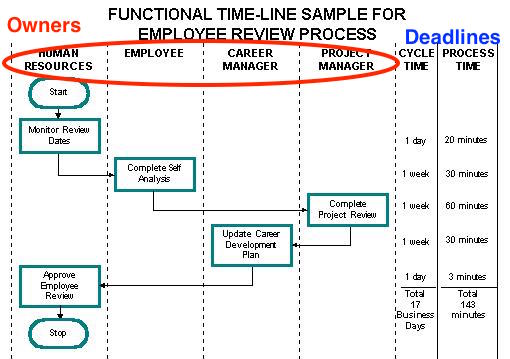
A workflow diagram maps your business process visually using standardized symbols traced back to engineers Henry Gantt and Frederick Taylor. Four main types serve different purposes: flowcharts, BPMN, swimlane, and SIPOC diagrams.
Most documentation tools solve the wrong problem. Stack Overflow surveys show developers waste over 4 hours per week searching for project information. The real fix is turning static docs into living workflows people follow.
A vendor onboarding checklist template turns ad-hoc supplier setup into a repeatable 5-phase process. W. Edwards Deming argued that supplier partnerships are critical to quality, and structured onboarding protects both sides from day one.
Case management handles non-routine work where the path forward is unclear. Grand View Research projects the market will exceed 15 billion dollars by 2030 as organizations recognize that human judgment cannot be automated away in unpredictable work.
Cost of quality is the price you pay for not getting things right the first time. Philip Crosby estimated it drains 20 to 25 percent of revenue through rework, defects, inspections and prevention across every workflow.
Compliance management is the process of tracking and enforcing rules across your organization. The Walmart Photo Center breach resulted in a roughly $1.3 billion settlement because the company knew about compliance requirements but never enforced them.
Organizational strategy is a living plan connecting your vision to daily execution. Michael Porter frameworks, FAST goals from MIT Sloan research, and why 60 to 90 percent of strategic plans fail at execution.
Offshore outsourcing takes outsourcing a step further. Giants like HP, IBM, Intel and Microsoft use it to cut costs and create round-the-clock productivity across time zones.
The 5W2H method from Kaoru Ishikawa and Toyota quality circles forces clarity with seven questions before work begins. One owner per task, real deadlines, and meeting minutes people act on.
Design failure mode and effect analysis, formalized in the AIAG-VDA handbook, helps engineering teams score risk across severity, frequency, and detection to find product defects before production. Learn how to run a DFMEA and prevent costly recalls.