
Ultimate Guide to Customer Success & How to Achieve It
Discover the models to customer success, the elements you should incorporate, and how to focus your efforts to drive revenue growth.
Summary
- Customer success means customers achieve their desired outcome through company interactions - This is proactive (preventing problems) versus customer service which is reactive (fixing problems after they happen); focuses on the entire customer journey across all teams, not just product use
- Drives 90% of revenue while dramatically reducing costs - Jason Lemkin of Storm Ventures notes the majority of revenue comes from post-sale customer relationships; retaining customers costs a fraction of acquiring new ones, reduces churn, and boosts renewals through trust instead of locked contracts
- Eight elements manage customer success systematically - Lincoln Murphy identifies Segmentation, Orchestration, Intervention, Measurement, Expansion and Renewal, Communication, Instrumentation, and Operationalization as the foundation for proactive customer journey management
- Five organizational models suit different company stages - FireFighter (small startups with one-stop-shop teams), Sales Oriented (competitive revenue focus), Service Oriented (mature companies aligning customer and company needs), Integrated (hyper-growth with Chief Customer Officer), and Partnership (complex products with high-value renewals). See how Tallyfy improves customer retention
Success gurus may tell you that in order for your business to succeed you have to have a certain mindset, drive, innovative products, engaging marketing, enthusiasm and a slew of “isms”.
Those things help, but the real success of any business is directly related to the success of your customer.
If you are helping solve problems, and the customers find success with your solutions, then they will continue using your product.
The biggest barrier to customer success is CEOs not making it an important part of the culture.
— Nick Mehta (CEO of Gainsight)
Continued business, and gaining new customers from word of mouth, is what customer success is all about. Achieving that takes more than a basic strategy. It requires a carefully planned process, process automation, the right people, the vision, and good data.
So, what is customer success?
The definition of customer success is simple - success occurs when your customers achieve the desired outcome through interactions with your company, either directly or through your product/service.
That can be broken down into two key elements in order to achieve success.
First, the desired outcome. Customers have a certain expectation, or result, they want the use of your product or service.
The other element is the interaction with your company. Since every company is different it’s not appropriate to just refer to interactions with your product. The focus should be on a broader scale, touching on interactions with the brand or company overall.
This is because success is not just about the use of the product. It comes from experiences at each stage of the buying cycle across different teams.
Customer success vs. customer service
While both customer success and customer service focus on customer-centric operations, they are different approaches.
Customer success is about establishing proactive programs, processes, operations designed to set your customers up for the best experience.
Customer service is a more reactive approach, tackling issues that arise after the fact.
Both are equally important since customer service programs and processes can lead to the discovery of opportunities to proactively take care of your customers.
Why customer success is important
Being proactive lays the groundwork for long-term customer success and has a number of benefits, including:
Boosting customer renewals
Customers have become put off my long-term contracts. They want the freedom to leave, even if they have no intention of it.
The days of locking people into lifetime contracts are over. That might scare you, but customers appreciate the trust.
With a focus on success, you will see improved renewals.
Reducing customer churn
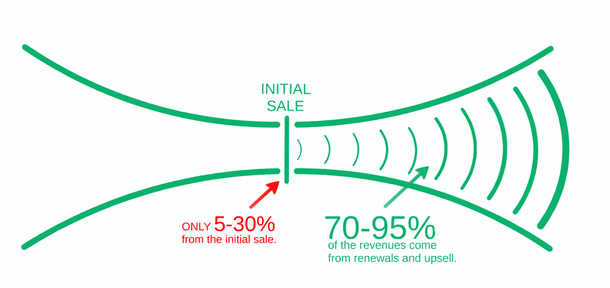
A lot of companies rely heavily on their marketing and acquisition strategies. While acquisition is important, it cannot be your sole focus. In our experience with workflow automation implementations, companies that focus exclusively on acquisition struggle to build sustainable growth. When global commercial real estate enterprises standardize their client onboarding and account governance processes across all offices, they achieve consistent service delivery regardless of location - the foundation for reducing churn.
Creating a customer success strategy ensures that fewer customers are lost, dramatically reducing customer churn. The more you increase the customer lifecycle, the greater the lifetime customer value.
You will also see reduced acquisition costs as more long-time customers refer others to your brand.
Customer success drives the revenue train
At a Gainsight Pulse conference (as of 2015), Jason Lemkin, the managing director of Storm Ventures said: “Customer Success is where 90% of the revenue is.”
Essentially, the majority of your revenue is going to come from your relationship with a customer post-sale. One that is built through continued engagement and nurturing.
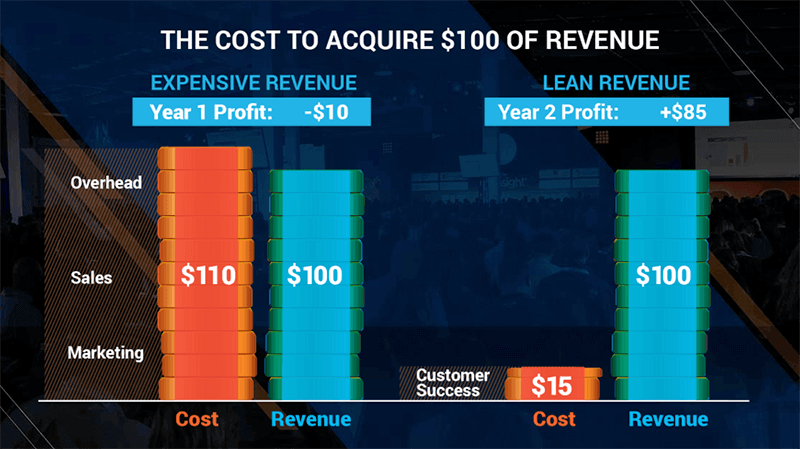
In the above, you can see a comparison of the costs of acquiring a new customer vs retaining the customers you already have.
As you can see, the cost to retain a customer is a fraction of those expenses involved in customer acquisition.
If you want to move beyond spreadsheets and ad-hoc check-ins, having structured processes for customer interactions makes a real difference. Here is how teams are approaching this systematically.
Customer Service Workflow Made Easy
Managing customer success
There are terrific benefits to customer success, but it’s not something that happens organically, or accidentally. Probably never has been.
Finding that success takes careful planning and management - essentially, the proactive orchestration of the customer’s journey toward their desired outcome
When you use words like “orchestration”, it is clear there is a fairly elaborate and defined process behind it.
Here are 8 elements to consider as part of customer success management:
- Segmentation
- Orchestration
- Intervention
- Measurement
- Expansion (and Renewal)
- Communication
- Instrumentation
- Operationalization
SixteenVentures goes into this full list in-depth, diving into each in this post from Lincoln Murphy
Customer Success Workflow Templates
Who is responsible for customer success?
You may have heard the old adage that everyone is involved in sales. The same concept really applies to customer success, because it does not stem from a single customer touch point.
Granted, some larger brands have dedicated teams for customer success and that makes it easy to point the finger at a specific department and say “that is their job.”
Most brands don’t have that.
Instead, customer success becomes a vision and purpose across the whole of the company. It’s in the job description for every employee from the top down.
When communicated effectively, everyone in the organization understands their role in helping customers achieve the desired outcome.
At Tallyfy, we’ve seen that every point at which a customer interacts with your brand (and staff) becomes a touch point and an opportunity for customer success.
What customer success is not
There are common misconceptions about what customer success is, and you have to be careful about your understanding of it before attempting to implement it and build a strategy for your own organization.
Too narrow a focus and you will be missing opportunities, spending vast resources to achieve minimal results - if any.
Customer success management can be tremendously powerful in helping you grow your business, but only if you understand what it’s not. This matters.
Customer success is not:
- Just a department you delegate tasks to, with an after-hours voicemail
- Simply limited to whoever is in charge of managing accounts
- Is not limited to (and should not be limited to) your customer service team
- About limiting or mitigating churn
- All about saving customers
- A method for babysitting customers to keep them from running away
- Simply a way to track product usage
- Your NPS and has very little to do with your net promoter score. NPS is just one factor in overall success
- Happiness, customer delight, or general satisfaction with how your company operates.
Common organizational models of customer success
Understanding who owns customer success at your company is a difficult part of the building process.
While it is true that many people are involved, there ultimately needs to be someone accountable for ensuring the programs work, and fixing things when something goes wrong.
There is no single way to structure your organization for customer success, but there are some common organizational models that you can follow.
FireFighter - Typically seen in smaller organizations or early-stage startups. In this model, customer success is responsible for supporting customers as well as relationship building and other post-sales activities that include renewals.
Under this model, your success management team becomes a one-stop-shop for customers. The downside is that this is not the most scalable model and you are under a great deal of pressure to get the right people in place on your team.
Sales Oriented - This model is most often seen in companies that do not have a very complex product but a competitive focus on sales and renewals.
A good example would be an e-liquid manufacturer driven to keep wholesale orders inbound with retail customers. This puts the focus on revenue and driving upsells.
The downside here is that the focus is less on the customer, and that can have a negative impact on the customer relationship.
Service Oriented - This is the model you will see in larger, more mature organizations. With this model, the company has aligned themselves with the needs of the customer while also meeting the needs of the company.
The downside to this is it often adds more touch points for the customer (which some could take negatively) and is not necessarily geared on driving revenue. There is still the revenue gain from improving customer success, but alignment to revenue with this model is not emphasized.
Integrated - This kind of model is most commonly seen in companies focused on hyper-accelerated growth, often with moderately complex products.
It is common to see a dedicated individual or Chief Customer Officer who owns existing customer success while driving the sales team on the acquisition of new customers.
Partnership - The partnership model is typical for companies with competitive sales and renewals of very complex products.
Customer success can remain very customer focused on this model despite longer and more complex relationship building, since renewal sales are often high value.
Conclusion
Customer Success may be a relatively new movement, leading us away from reactive customer service models, but it is effective and needs to be more widely adopted.
Especially since the core concepts of customer success are not really new for many companies. Only the perspective and strategies in how the elements work together to help customers reach their goal.
If growth is what your organization is looking for then invest in customer success and create strategic initiatives.
Bring your teams together with a singular purpose of making your buyers more successful so the entire organization is aligned around the same concept. In our conversations with operations leaders across financial services, healthcare, and professional services firms, we have observed that this alignment is what transforms good companies into great ones. One consulting firm COO told us that by “forcing ourselves to write out the processes,” their team ensured consistent delivery and fewer mistakes - the essence of customer success.
About the Author
Amit is the CEO of Tallyfy. He is a workflow expert and specializes in process automation and the next generation of business process management in the post-flowchart age. He has decades of consulting experience in task and workflow automation, continuous improvement (all the flavors) and AI-driven workflows for small and large companies. Amit did a Computer Science degree at the University of Bath and moved from the UK to St. Louis, MO in 2014. He loves watching American robins and their nesting behaviors!
Follow Amit on his website, LinkedIn, Facebook, Reddit, X (Twitter) or YouTube.

Automate your workflows with Tallyfy
Stop chasing status updates. Track and automate your processes in one place.